Regulatory
Five EU regulations. One verification layer.
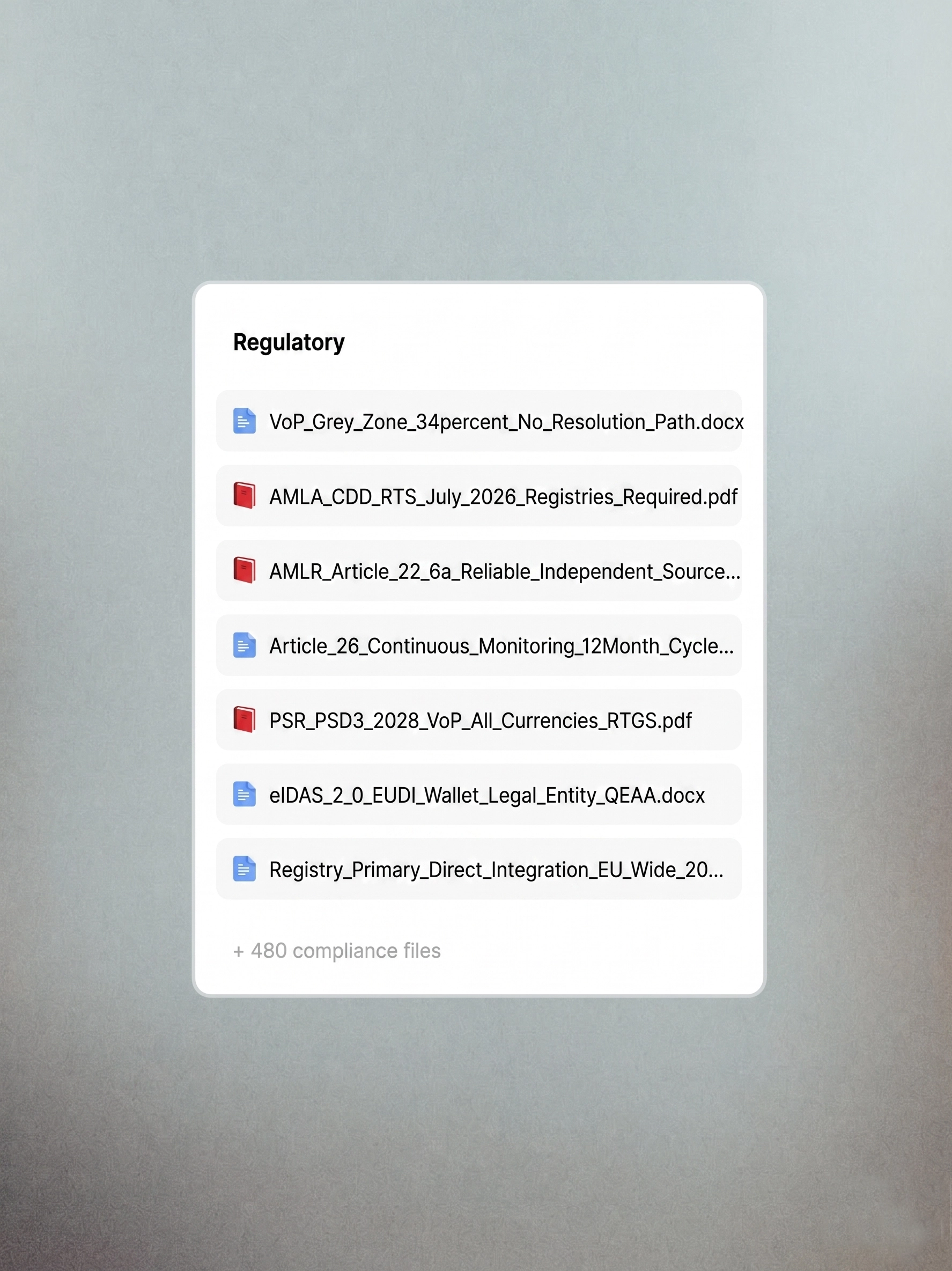
The EU's payment compliance landscape is being rebuilt from the ground up. VoP is live. AMLR is coming. PSR doubles the scope. sikker.me is architected for the full wave sequence — not patched for each new requirement as it arrives.
Timeline
Where we are. Where we're going.
Oct 2025 — Live
Verification of Payee (IPR 2024/886)
Mandatory for all Eurozone PSPs. 34% of French-market VoP transactions return grey-zone results — no automated resolution path exists. (Natixis CIB, March 2026, based on STET Sepamail data, 180M transactions) Every decision must be documented.
What VoP does
Before a SEPA credit transfer, the payer's bank sends a name-IBAN consistency check to the payee's bank. Four results: Match / Close match / No match / Unable to verify.
What VoP cannot do
- Check government registries (only the bank's own record)
- Detect company dissolution, director changes, ownership transfers
- Resolve its own grey-zone results (close match / unable to verify)
- Monitor changes after the payment check runs
- Cover non-SEPA or non-euro payments (until PSR/PSD3, ~2028)
Compliance consequence
For consumer-initiated SEPA credit transfers, a PSP that executes on a no-match result without documenting it loses the PSD2 liability shield under Article 5c(9) of the IPR. For corporate B2B payments, the compliance exposure is a documentation burden — every grey-zone decision must be recorded and defensible in a regulatory examination.
Jul 2026
AMLA submits CDD RTS to European Commission
The RTS will define which sources qualify as "reliable and independent" for identity verification under Article 22(6)(a). Requirements apply July 2027. Procurement clock: 6–9 months.
Article 22(6)(a) is already in force: identity verification must use "reliable and independent sources." Government registries — Firmenbuch, Handelsregister, KvK, and equivalents — are the authoritative record at source. Aggregators are downstream of the same data with added latency. That distinction matters to a regulator reviewing your methodology today, not just after the RTS enters into force.
From July 10, 2027: the RTS codifies this standard precisely. sikker.me is registry-primary from day one.
Jul 2027
AMLR Regulation 2024/1624
Factoring and invoice financing become obliged entities. Explicitly named under CRD IV Annex I, Point 2. No size threshold. No exemption for dedicated businesses.
Key obligations
- Art. 22(6)(a): verify against reliable, independent sources — official government registries
- Art. 26: continuous monitoring, mandatory 12-month or 5-year update cycles, event-triggered refresh
- Art. 20(1)(h): identify natural persons for whose benefit transactions are conducted (directors, UBOs)
Penalties: up to 10% of annual turnover or €10M.
2027–2028
PSR / PSD3
VoP extends to all EU currencies and RTGS flows. Platform liability for fraud originating on their infrastructure.
Dec 2027
eIDAS 2.0
EUDI Wallet acceptance mandatory for PSPs. Legal entity QEAAs: company attributes verifiable via wallet.
Coverage
Built for the sequence. Not patched for each wave.
| Regulation | Obligation | sikker.me |
|---|---|---|
| VoP / IPR 2024/886live | Resolve grey-zone results. Document liability basis. | Registry verdict. Full audit trail. |
| AMLA CDD RTSJul 2026 | Registry-sourced verification as compliance baseline. | Registry-primary architecture |
| AMLR Art. 22(6)(a)Jul 2027 | Verify against reliable, independent sources. | Direct government registry integrations |
| AMLR Art. 26Jul 2027 | Continuous monitoring + documented update cycles. | Automated monitoring + refresh records |
| PSR / PSD3~2028 | VoP for all EU currencies and RTGS flows. | Multi-registry, multi-jurisdiction |